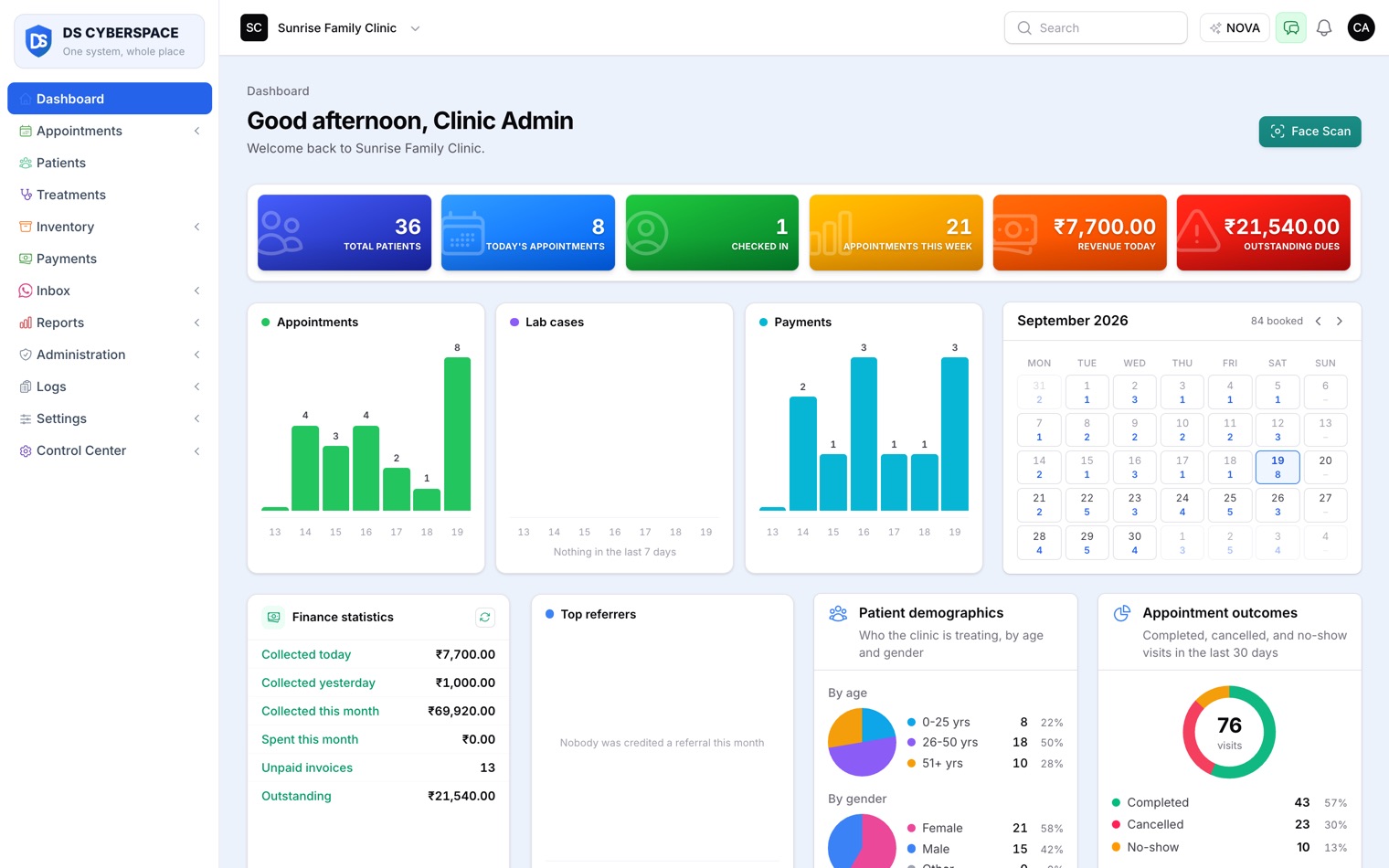
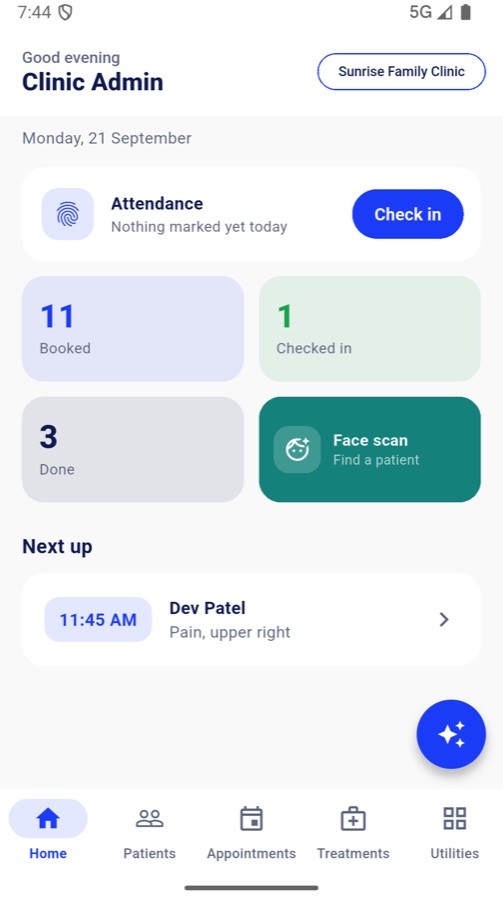
Appointments, patients, treatments, billing, stock, staff payroll and reports — one place the whole desk works from, at the counter and on the phone in your pocket.
A booking link patients open from WhatsApp, reminders that go out on their own, and recalls that raise themselves.
Check-in, case paper, tooth chart and prescription on one screen, so nothing is written twice.
Invoices, part payments and dues in one place, and a month-end report that already knows who did what.
Not six tools that have to be told about each other. One, where the appointment becomes the visit, the visit becomes the invoice, and the invoice turns up in the month's report.
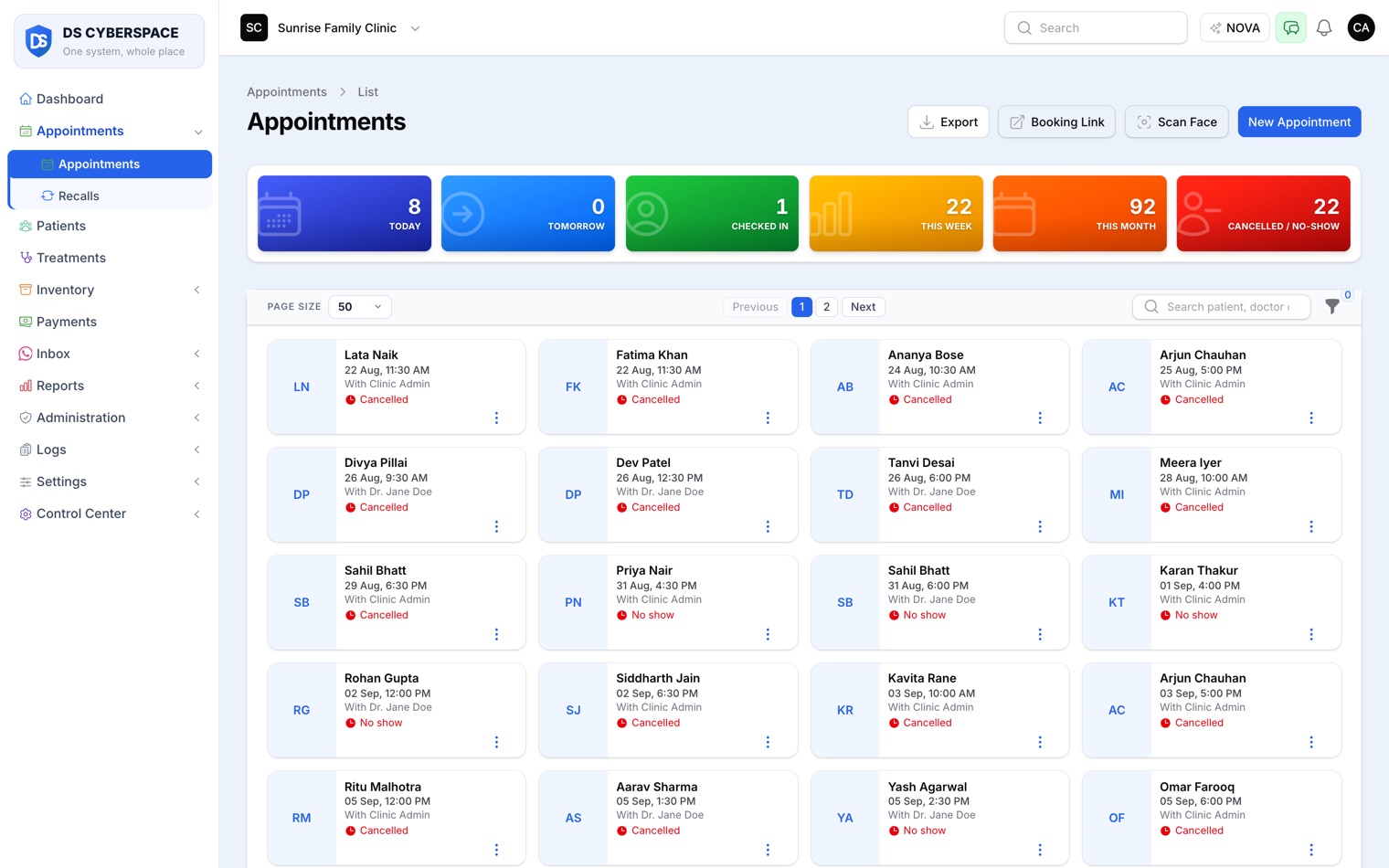
Book a demoBook, move and confirm the diary. Reminders go out on their own, and the booking link can be shared straight into a WhatsApp message.
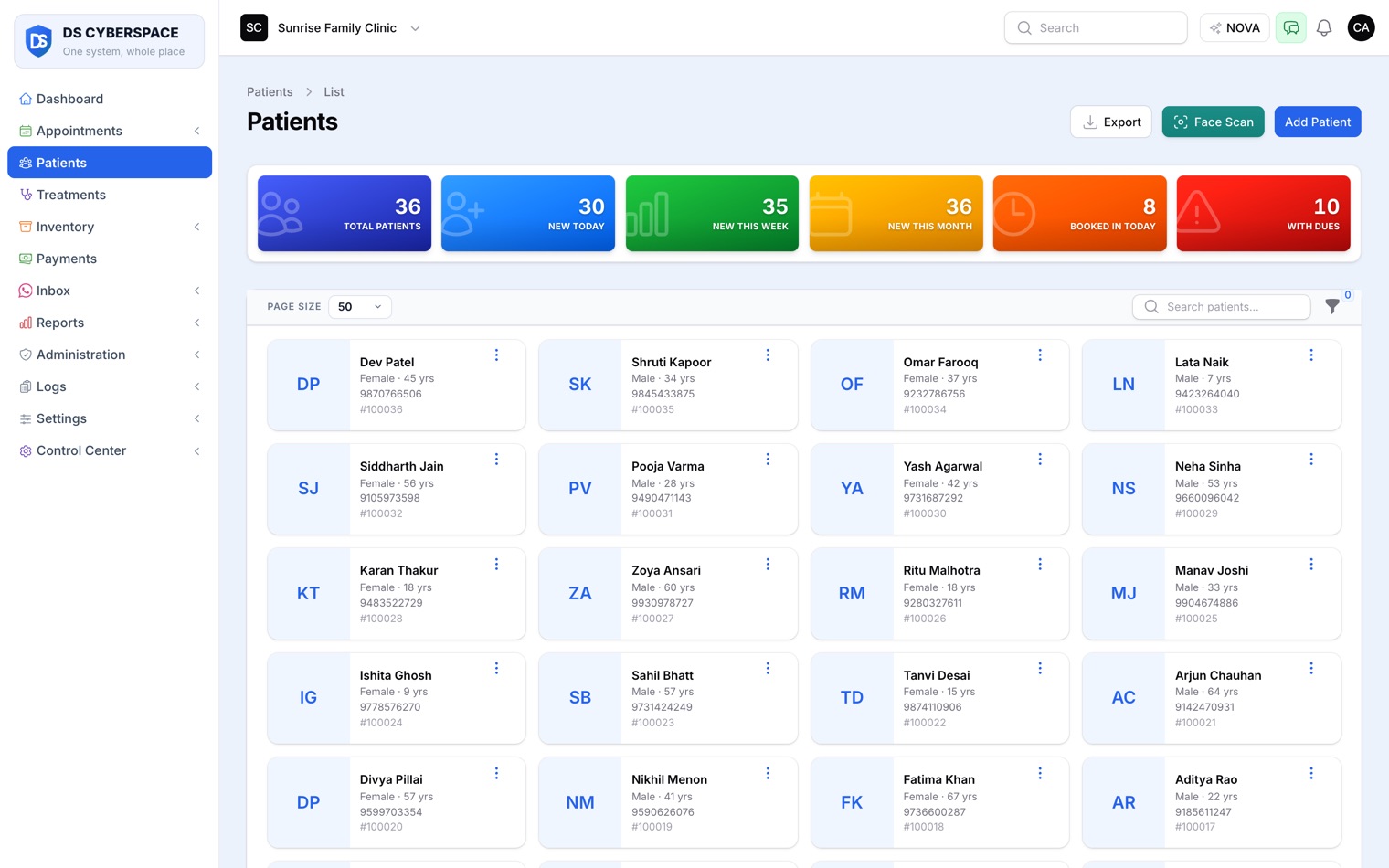
Records, history, X-rays and documents kept together per patient, with the tooth chart on the same screen as the notes.
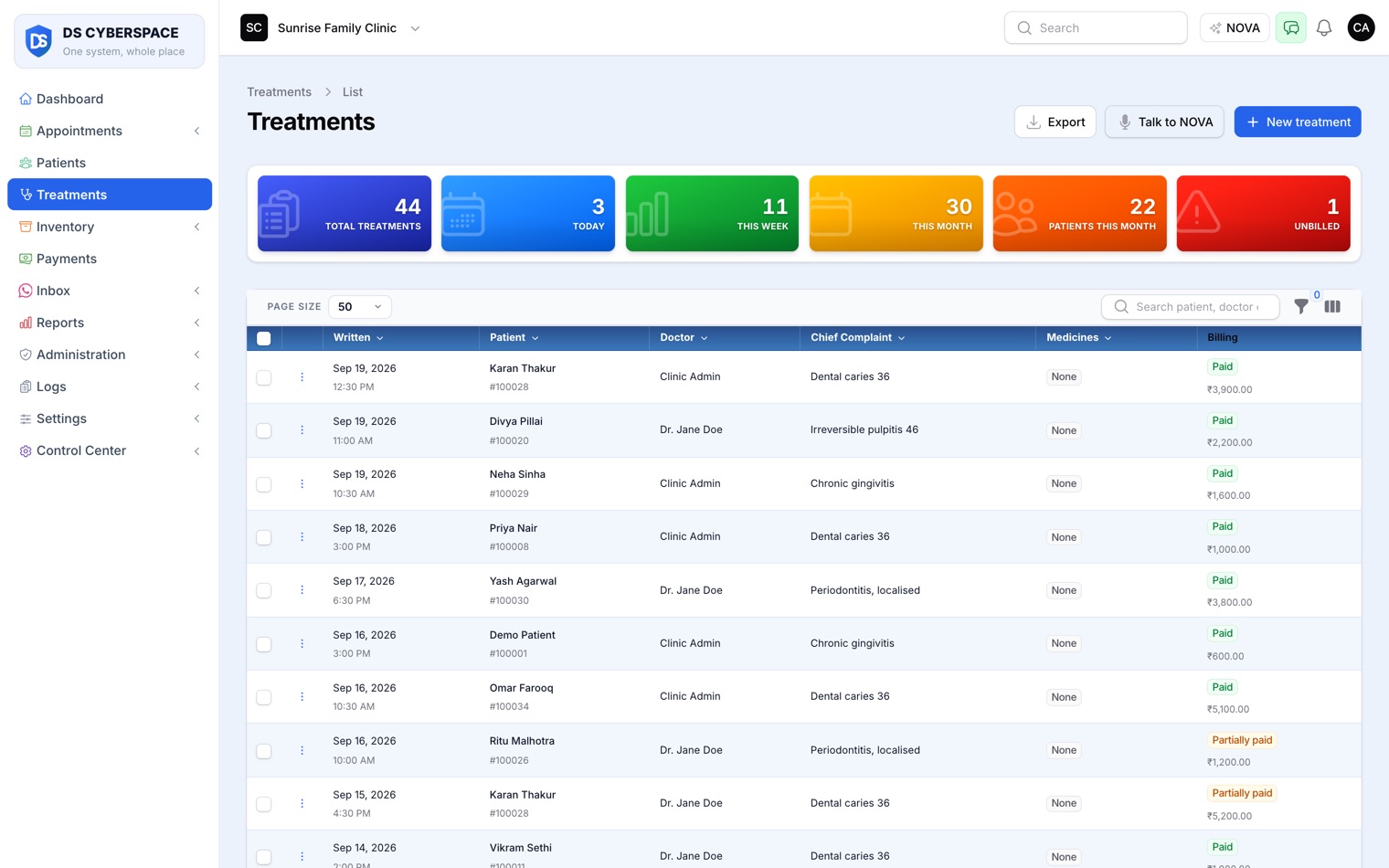
Write up a visit, plan the next one, and track what has been done. The prescription and the invoice print together.
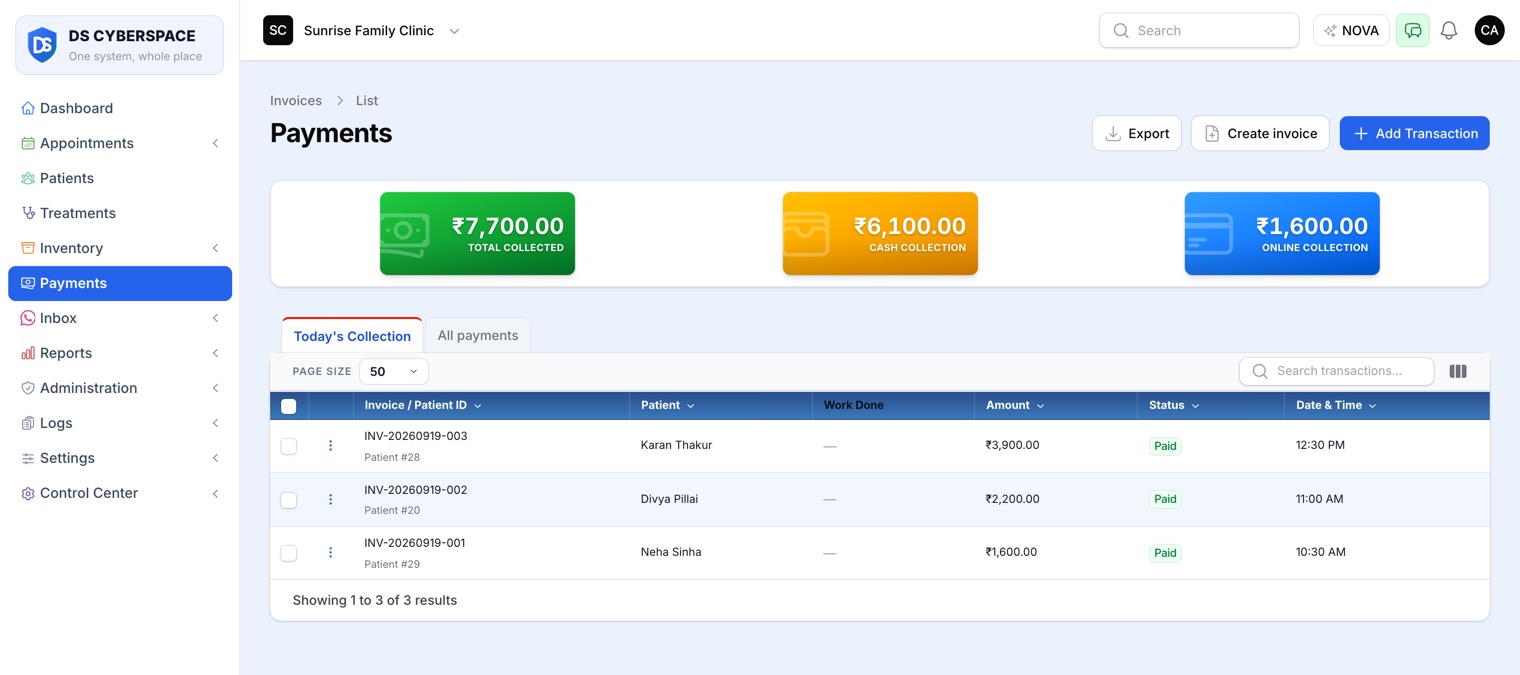
Raise invoices, take payments and see what is still owed. Online payment is there when the clinic wants it.
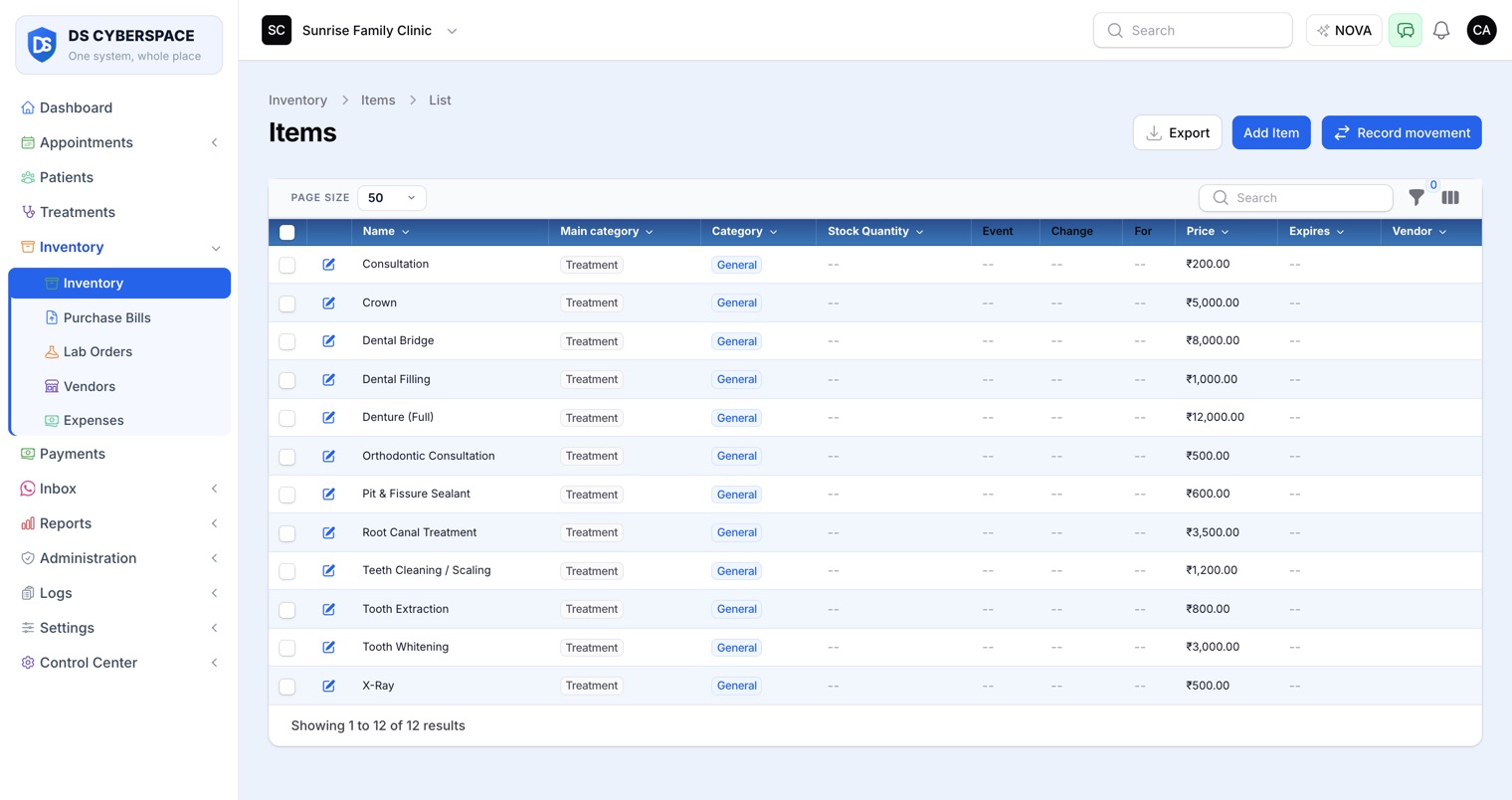
Stock, vendors and purchase bills in three sheets that work like a spreadsheet, so the desk does not have to learn a new shape.
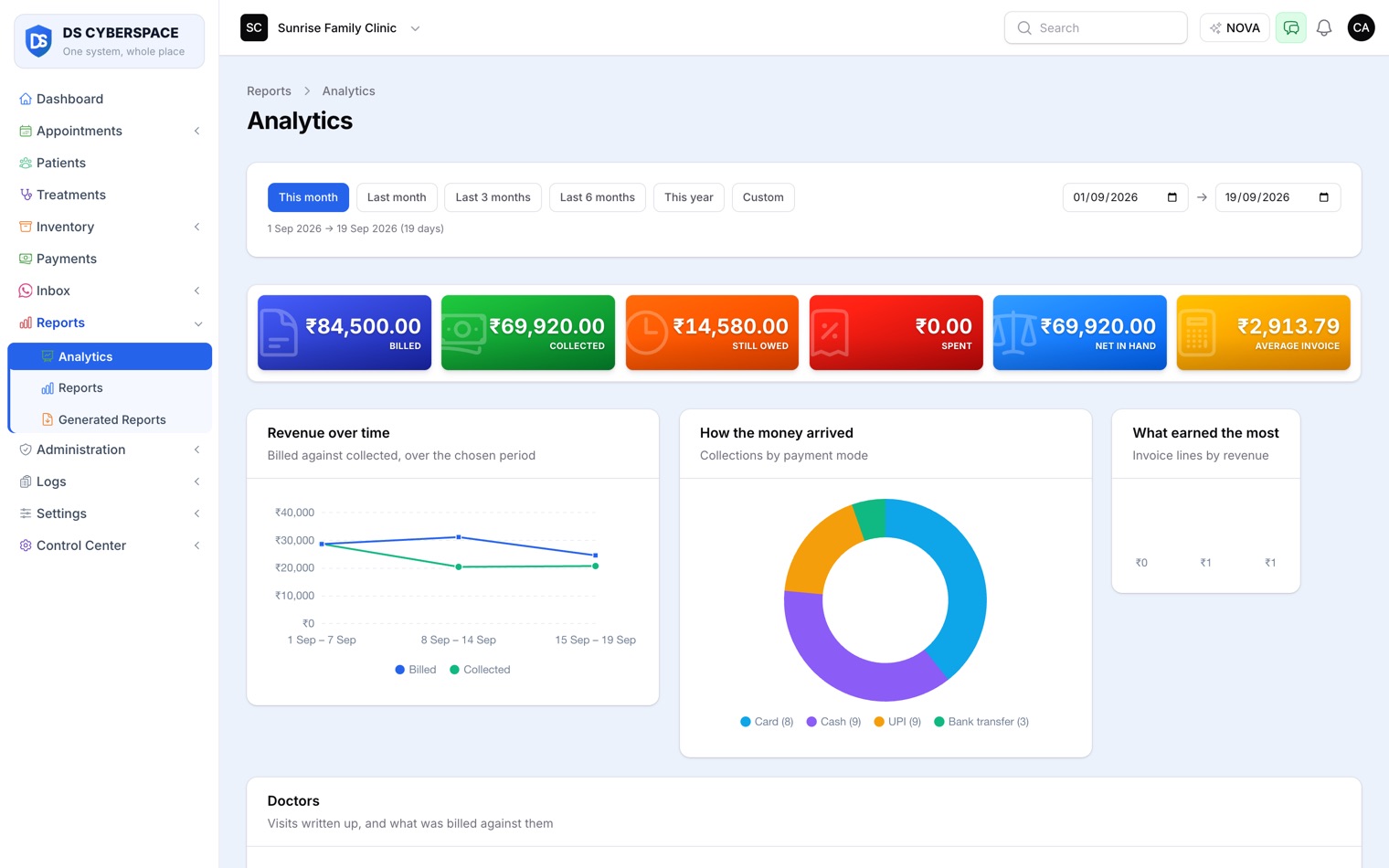
Where the month actually went -- collections, treatments, and what each doctor and each chair did.
None of it costs extra, and none of it needs a second account.
Two-way patient chat, with the clinic's replies drafted and sent from the same screen.
The patient's policy on their record, and a claims book that tracks what was claimed, approved and settled.
Patients see their appointments, prescriptions and invoices, and book their next visit themselves.
One room the doctor opens from the panel and the patient from their portal.
Outside doctors and health advisers, what they sent, and what they have earned on it.
A message at each dose of the prescription, for the length of the course.
One patient's day, start to finish, without anything being typed twice.
The patient books from the clinic's link, or the desk books them in. The reminder goes on its own.
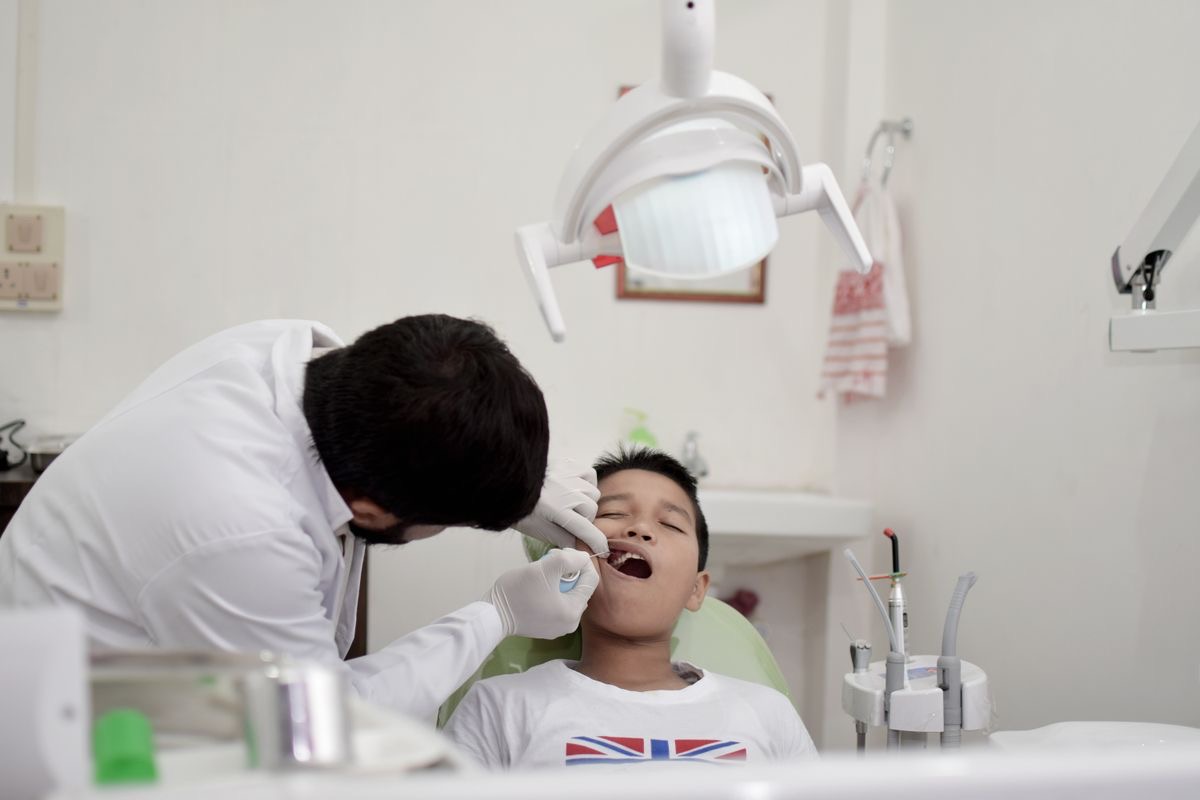
Notes, tooth chart, prescription and lab case are written against the visit, at the chair.
The invoice is raised off the treatment. Part payments and what is still owed stay tracked.
Collections and each doctor's work add up into the month, with no spreadsheet in between.
Appointments and invoices are only the start. These are the parts of a clinic's day DentaSetu also takes on — from the chair to the staff room.

Talk while you treat. NOVA writes the teeth, findings, treatment and medicines into the case paper and learns your clinic's own words. It is understood by DentaSetu itself, not sent to an outside AI service.

Staff check in on their phone, checked by location and then by face, so nobody marks in for a colleague. The month's salaries are worked out from it.
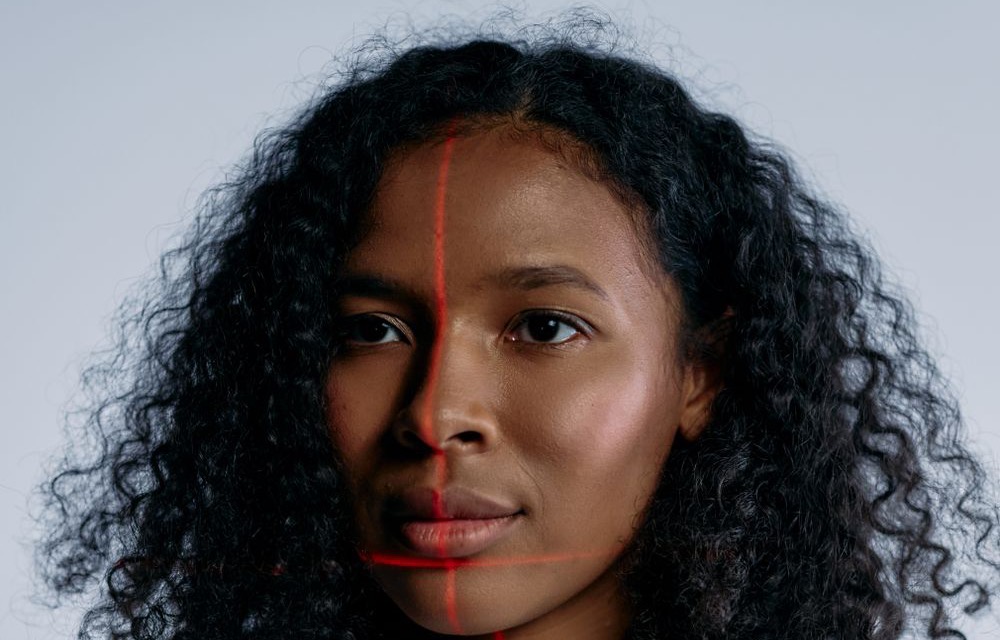
Point the desk camera or a phone at a returning patient and their record opens. The face is read on the device, and no photograph leaves it.
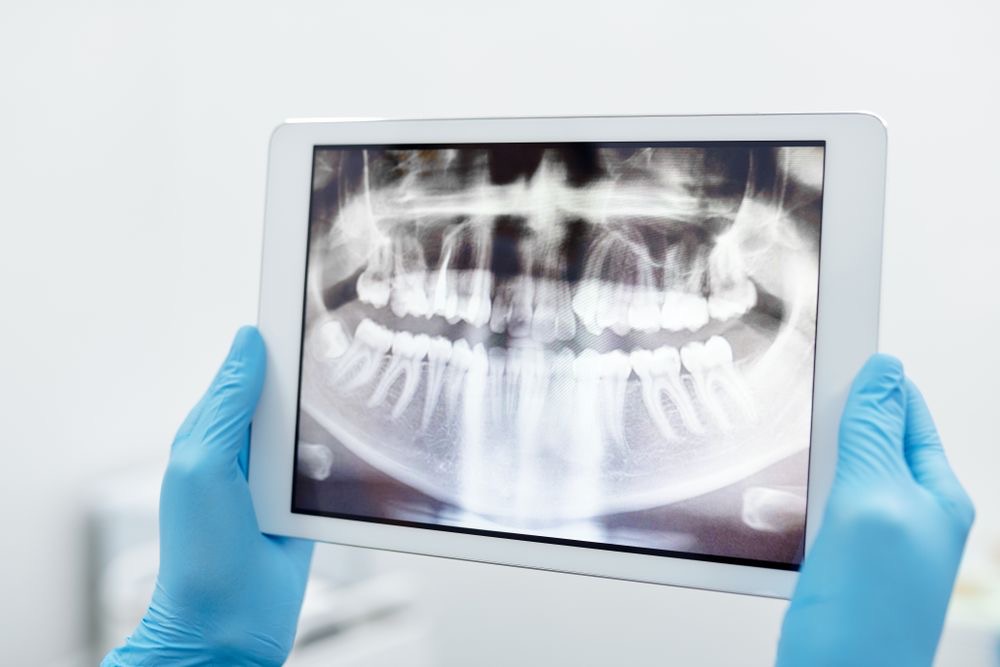
Camera, X-ray and oral-scan files go straight onto the tooth being treated, and the lab gets the original scan on a signed link. No login, no pen drive.
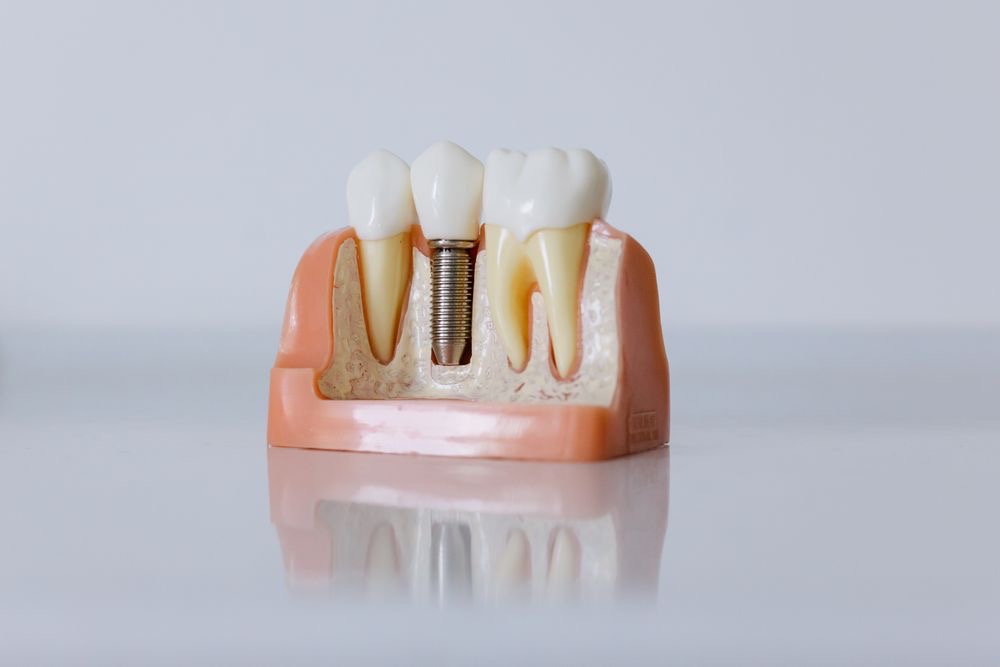
System, size, lot and serial for every fixture, a five-stage timeline and an implant card sent to the patient. The ortho log fills itself from the case paper.
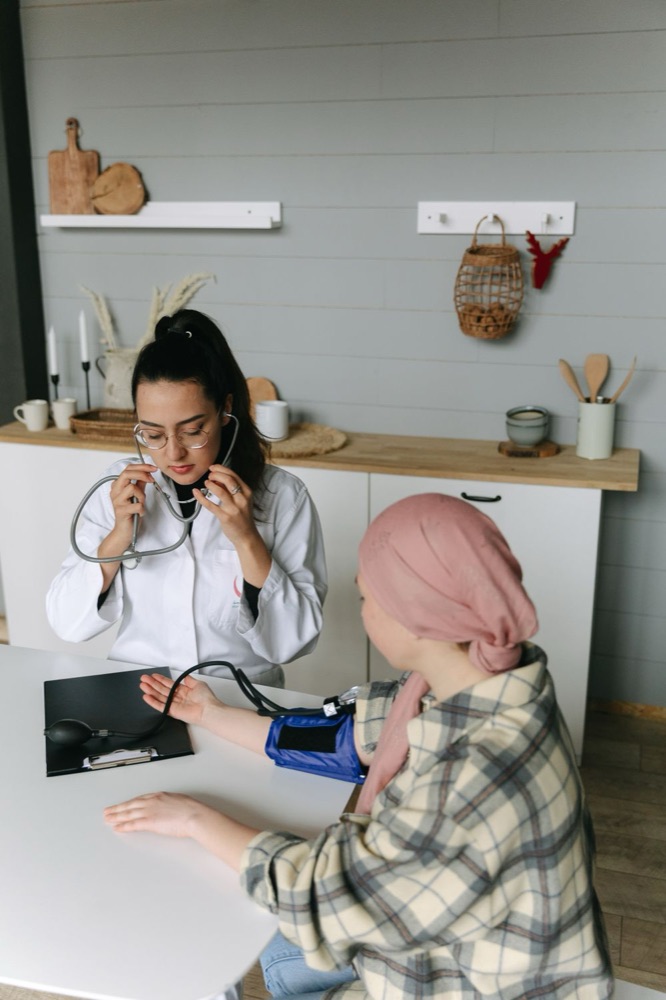
Assigned, on the way, arrived, done. Each stage is stamped, and the patient is told as it happens.
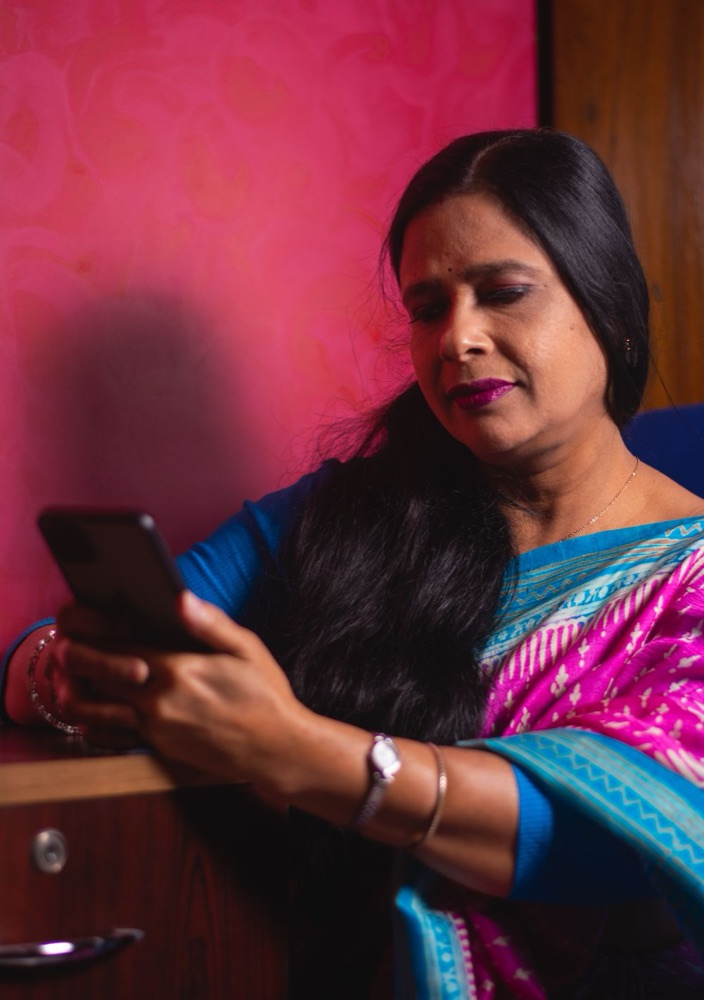
Patients sign in to the DentaSetu app for their appointments, visits and bills, and chat with the clinic there, with nothing charged per message.
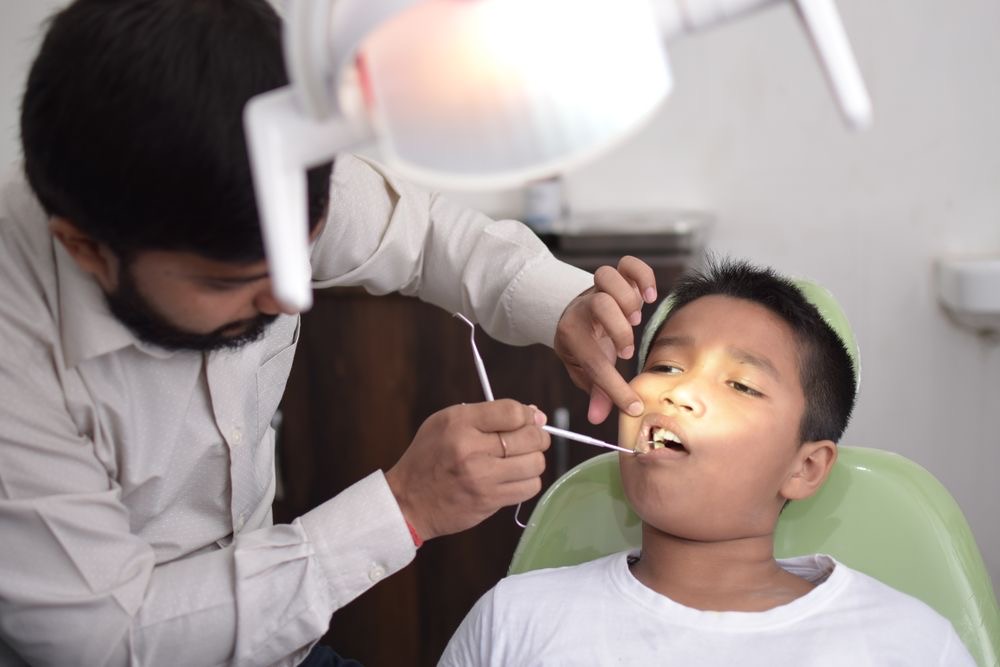
Every patient comes up for a check-up six months after their last visit, without anybody ticking a box. The doctor only sets the reviews they mean.
Collections and each doctor's work, daily, weekly or monthly, on WhatsApp, SMS or a phone call that reads them out.
The staff app for the chair and the door, the desktop app for the counter.
Ten Acts and codes govern a dental practice in India. Here is what each one asks for, and what this software does about it.
What this is, and is not. These describe how DentaSetu is built. They are not a certification, an audit or a legal opinion, and none has been issued — a clinic stays responsible for its own registrations, its own consent and its own filings, and software only makes them easier to keep. Where we are not yet there, it is said so here. Details of what is stored, where, and who answers for it are on the data protection page, and anything else we will answer on a call.
The clinic is the data fiduciary and we are its processor -- said in those words on the data protection page, along with where the data sits, who answers a complaint and what a patient can ask for. Patient data is held on servers in India, it is never sold, shared or used to train anything, and one clinic cannot see another clinic's records.
Consent is asked for a purpose and can be withdrawn. Every kind of automatic message has its own switch, a patient can be taken off messaging entirely, and the notice they are shown is plain language rather than a wall of clauses. Who can open what is set by role, and a named grievance contact is published rather than buried.
Traffic runs over HTTPS on a real certificate, passwords are hashed and never stored readable, and a patient's files and a lab's case are reached through signed links that expire -- so an outside party never needs a login to lose. Reasonable security practice here is the build, not a policy document about one.
DentaSetu is practice-management software. It does not diagnose, it does not measure a patient and it does not drive any instrument, so it is not itself a regulated device -- and no licence is claimed that would not be granted. What it does is keep the device side legible: an implant is entered off its packet with the system, the size and the lot number, so a recall can be traced to the patients it reached.
The ABDM consent model is built the way ABDM asks for it: a record becomes a care context only after the patient links it, health information leaves encrypted and only for the purpose and the period the consent names, and withdrawing it stops the flow. A clinic switches this on with its own ABDM credentials. It is built and tested against ABDM's sandbox and is not yet certified on production -- which is said here rather than left to be assumed.
Each dentist on the account carries their own council registration number and qualifications, and the prescription that prints carries them beside the treating dentist's name. The work is recorded against the dentist who did it, which is what a complaint or an inspection asks to see.
The establishment's registration number, the authority that issued it and its expiry are kept on the clinic's own record. Every visit leaves a case paper -- notes, tooth chart, prescriptions, lab work, images -- and a patient taken off the list is archived rather than erased, so the record is still there when it is asked for.
Informed consent is kept with the visit it was given for: the signed form as a photograph and a short clip of the patient saying so out loud, both attached to that treatment rather than to a filing cabinet. The plan, what was quoted and what was paid are each dated, so the clinic can show what was agreed before the work started.
The clinic's GSTIN prints on its invoices, each line can carry its HSN code and its own rate, and the tax on an invoice is what those lines add up to rather than a figure typed at the bottom. Purchase bills keep the vendor's GST number against them, so the month closes out of the same records the clinic already keeps.
A video consultation is one room the doctor opens from the panel and the patient from their own portal, so both ends are identified before the call and the consultation hangs off that patient's record. What was advised and what was prescribed is written up as a visit like any other, and the prescription carries the dentist's name and registration.
The plans as they stand, with what each one includes. Tell us the size of the practice and we will tell you which one it sits in.
Pay only for the appointments you book. A quiet month costs little.
₹30 / appointment
One clinic, every module, one flat monthly price.
₹999 / month
The main clinic and up to 8 more branches on one account.
₹999 / month
+ ₹500 / branch / month beyond 1
More than 9 branches, or a chain with its own needs.
On request
Every clinic starts on a trial. Nothing is charged until the practice is approved and says to go ahead.
Tell us about the practice and we will walk you through it — on a call, or sitting at your counter if you are nearby.